Friday, February 27, 2009
Promethease 0.1.46 released
Promethease 0.1.46 is released. It is worth upgrading. The most visible change is in how the status window updates. Many other improvements are here too.

Tuesday, January 6, 2009
Friday, August 8, 2008
Friday, July 18, 2008
0.1.24 public genomes
Promethease 0.1.24 has been released.
A growing collection of public genomes allows you to see how magnitudes have improved the system.
A growing collection of public genomes allows you to see how magnitudes have improved the system.
Sunday, February 24, 2008
Mendelian Inheritance
Promethease 0.1.8 now available with an important new feature called a genoset. Genosets allow us to talk about specific combinations of SNPs.
As an example: 77% of Europeans who lack the rs4988235(T) and rs182549(A) haplotype will be lactose intolerant.
Previous releases could show you had the high risk form of each, but it couldn't highlight that you actually had both. Genosets resolve this. Each genoset gets a unique gs#, similar to an rs#. It also has a criteria which must be met for you to see the consequence. It works like the connection between a genotype and a phenotype.
Here is the genoset which predicts lactose intolerance and it's criteria
http://www.snpedia.com/index.php?title=gs100
http://www.snpedia.com/index.php?title=gs100/criteria
A criteria is a little computer program which evaluates to True or False for your specific genotypes. If True, your report will show the text from the main genoset page. Relax, only hardcore SNPedians will ever see another criteria.
Here's what the promethease reports look like for 23andMe's demo user Lilly Mendel and Greg Mendel.
Lilly Mendel should have no problems with lactose. Greg Mendel is probably lactose intolerant and may also be at increased risk of ALS. But look just below that and you will see that both Mendels carry a rare rs4253208(G;G).
Here from 23andMe's original file is the raw data
And NCBI/HapMap shows that the the (G;G) genotype is possible but rare. In fact it even suggests the Mendels may be closer to African than European ancestry?!
What's actually happening is strand confusion. SNPedia is oriented to NCBI dbSNP. 23andMe probably oriented to the opposite strand. However, there is nothing in their data file which indicates this. Without it, promethease has to recognize the (G;G) as possible.
deCODEme's file format does pass strand information, but perhaps the time has come to consider what a long-term personal genomics file format should look like. XML is well suited to this. Strand information is clearly important. I'd discourage 23andMe's fondness for pushing both allele's together to avoid confusion when dealing with multinucleotide snps such as rs34815109. Ideally it would also be able to handle sequence information since microarrays can't really see haplotypes.
Lastly, several people have reported seeing the message 'Not a win32 application' when trying to run promethease. It seems all were caused by failed downloads. If you see that message please ensure you have the full 7M file from
http://www.snpedia.com/files/promethease/promethease.exe
As an example: 77% of Europeans who lack the rs4988235(T) and rs182549(A) haplotype will be lactose intolerant.
Previous releases could show you had the high risk form of each, but it couldn't highlight that you actually had both. Genosets resolve this. Each genoset gets a unique gs#, similar to an rs#. It also has a criteria which must be met for you to see the consequence. It works like the connection between a genotype and a phenotype.
Here is the genoset which predicts lactose intolerance and it's criteria
http://www.snpedia.com/index.php?title=gs100
http://www.snpedia.com/index.php?title=gs100/criteria
A criteria is a little computer program which evaluates to True or False for your specific genotypes. If True, your report will show the text from the main genoset page. Relax, only hardcore SNPedians will ever see another criteria.
Here's what the promethease reports look like for 23andMe's demo user Lilly Mendel and Greg Mendel.
Lilly Mendel should have no problems with lactose. Greg Mendel is probably lactose intolerant and may also be at increased risk of ALS. But look just below that and you will see that both Mendels carry a rare rs4253208(G;G).
Here from 23andMe's original file is the raw data
| rsid | chromosome | position | genotype | |
| rs4253208 | 10 | 50348728 | GG |
And NCBI/HapMap shows that the the (G;G) genotype is possible but rare. In fact it even suggests the Mendels may be closer to African than European ancestry?!
What's actually happening is strand confusion. SNPedia is oriented to NCBI dbSNP. 23andMe probably oriented to the opposite strand. However, there is nothing in their data file which indicates this. Without it, promethease has to recognize the (G;G) as possible.
deCODEme's file format does pass strand information, but perhaps the time has come to consider what a long-term personal genomics file format should look like. XML is well suited to this. Strand information is clearly important. I'd discourage 23andMe's fondness for pushing both allele's together to avoid confusion when dealing with multinucleotide snps such as rs34815109. Ideally it would also be able to handle sequence information since microarrays can't really see haplotypes.
Lastly, several people have reported seeing the message 'Not a win32 application' when trying to run promethease. It seems all were caused by failed downloads. If you see that message please ensure you have the full 7M file from
http://www.snpedia.com/files/promethease/promethease.exe
Monday, January 14, 2008
Promethease deCodes 23andMe
Promethease annotates your genome using SNPedia.
It is possible thanks to the Personal Genome Explorer which allows 23andMe customers to export all of their 550,000 genotypes. Promethease reads this export format, and uses it to generate sample reports.
Your genotypes will probably be a bit more boring, since these random files get some pretty weird diseases. The report format isn't yet as intuitive as it should be, but you'll manage.
Your changes to SNPedia will appear in future reports. To generate a report simply drop an export file onto promethease.exe . From the DOS command line you can compare to other hapmap populations, instead of the default CEU. Runtime is about 2 hours. It doesn't eat much of your net or cpu, it just moves slowly to be courteous to others.
PGE does not yet provide information to orient snps relative to dbsnp. As a result many of the genotypes are flipped. This causes Promethease to ignore population frequencies. These SNPs will show with a 'None' along their left side.
http://www.snpedia.com/files/promethease/promethease.exe
It is possible thanks to the Personal Genome Explorer which allows 23andMe customers to export all of their 550,000 genotypes. Promethease reads this export format, and uses it to generate sample reports.
Your genotypes will probably be a bit more boring, since these random files get some pretty weird diseases. The report format isn't yet as intuitive as it should be, but you'll manage.
Your changes to SNPedia will appear in future reports. To generate a report simply drop an export file onto promethease.exe . From the DOS command line you can compare to other hapmap populations, instead of the default CEU. Runtime is about 2 hours. It doesn't eat much of your net or cpu, it just moves slowly to be courteous to others.
PGE does not yet provide information to orient snps relative to dbsnp. As a result many of the genotypes are flipped. This causes Promethease to ignore population frequencies. These SNPs will show with a 'None' along their left side.
http://www.snpedia.com/files/promethease/promethease.exe
Saturday, December 8, 2007
GBrowse SNPedia
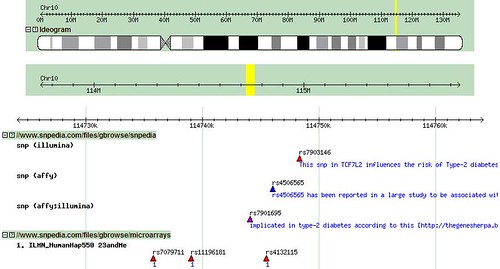
It is now easy to overlay SNPedia on the Gbrowse databases. This means you can generate images like
(click for full)
which shows a cluster of snps around TCF7L2. The upper track identifies SNPedia snps. The the lower track identifies all snps present on the Illumina 550 microarray. All are hyperlinked to their SNPedia pages. If you click on the image above, you'll see the full image with the LD plot at the bottom. This allows you to determine how much two neighboring snps can say about each other.
To generate your own visit the hapmap of Chr10:114724078..114764077
At the very bottom of the page add these two 'remote annotation urls'
http://www.snpedia.com/files/gbrowse/snpedia
http://www.snpedia.com/files/gbrowse/microarrays
The snpedia file is a modest 300kbytes, but the single illumina chip is 58Mbytes!
Every snpedia rs# page now has a direct link to the hapmap site. Loading will take a while. Scenic spots along the genome include:
rs7901695
*click on hapmap
*set Scroll/Zoom=40kbp (upper right)
rs9939609
*click on hapmap
*set Scroll/Zoom=100kb (upper right)
I'm aware of a problem with rs3135506, but unable to explain it. Other times, snps listed in the snpedia files files aren't rendering onto the images. Other bugs probably remain. Your bug reports are always helpful.
Annotations will be updated approximately weekly, along with the fasta.
(click for full)
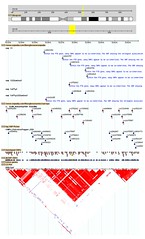
which shows a cluster of snps around TCF7L2. The upper track identifies SNPedia snps. The the lower track identifies all snps present on the Illumina 550 microarray. All are hyperlinked to their SNPedia pages. If you click on the image above, you'll see the full image with the LD plot at the bottom. This allows you to determine how much two neighboring snps can say about each other.
To generate your own visit the hapmap of Chr10:114724078..114764077
At the very bottom of the page add these two 'remote annotation urls'
http://www.snpedia.com/files/gbrowse/snpedia
http://www.snpedia.com/files/gbrowse/microarrays
The snpedia file is a modest 300kbytes, but the single illumina chip is 58Mbytes!
Every snpedia rs# page now has a direct link to the hapmap site. Loading will take a while. Scenic spots along the genome include:
rs7901695
*click on hapmap
*set Scroll/Zoom=40kbp (upper right)
rs9939609
*click on hapmap
*set Scroll/Zoom=100kb (upper right)
I'm aware of a problem with rs3135506, but unable to explain it. Other times, snps listed in the snpedia files files aren't rendering onto the images. Other bugs probably remain. Your bug reports are always helpful.
Annotations will be updated approximately weekly, along with the fasta.
Subscribe to:
Posts (Atom)